



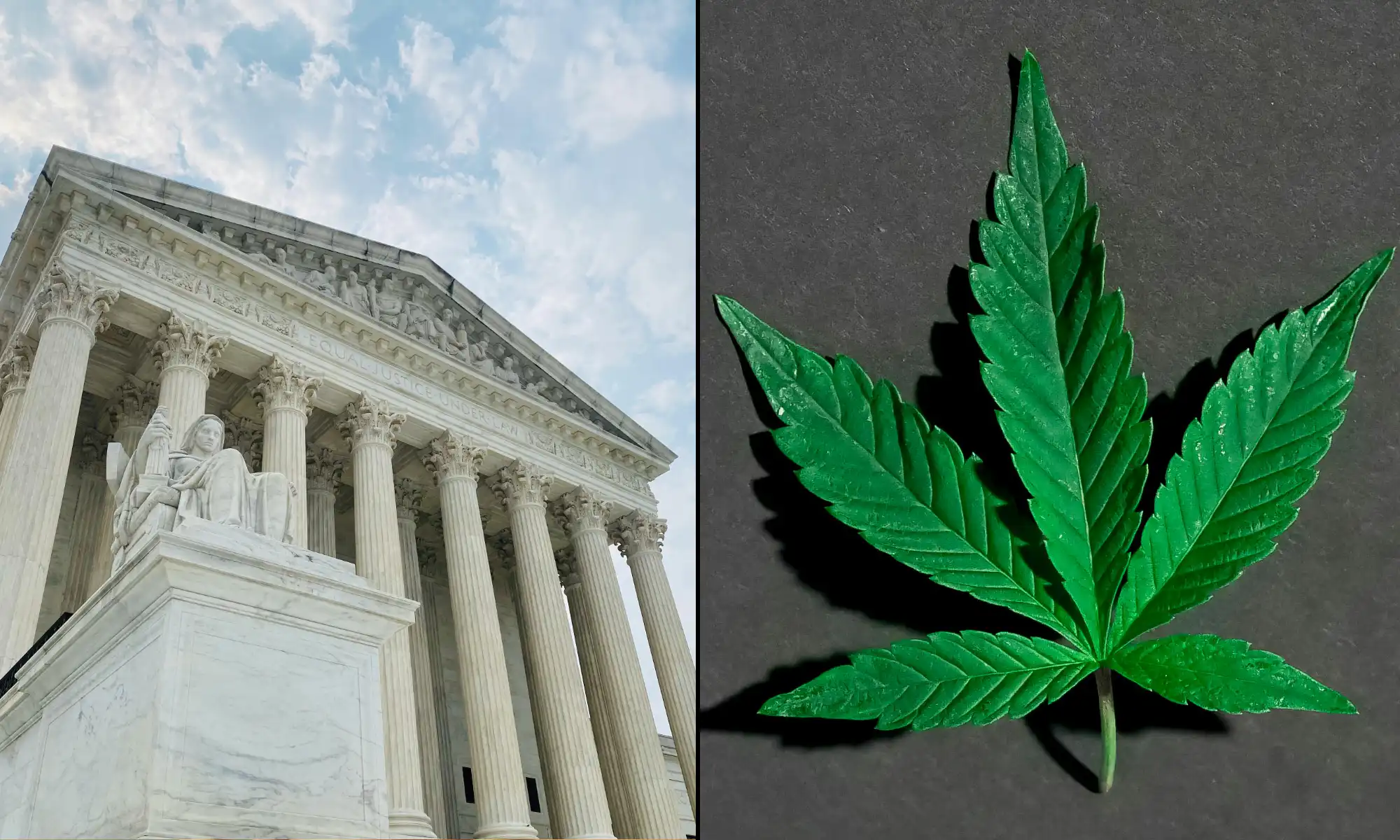
The U.S. Supreme Court is being asked to resolve a split among lower courts about whether state marijuana business licensing systems can discriminate against out-of-state residents.
The operator of companies that sought and were denied cannabis business licenses in Washington State and Sacramento, California due to his residency status filed a petition last week asking the justices to overturn an appeals court ruling that found that the Constitution’s Dormant Commerce Clause does not apply to federally illegal activities.
The Supreme Court has interpreted that clause to bar protectionist state laws that unduly restrict interstate commerce even in areas where Congress has not directly weighed in. Federal appeals courts have disagreed on its application to the marijuana industry, however.
Now, Michigan resident Kenneth Gay wants the Supreme Court to step in and reverse a ruling from the U.S. Court of Appeals for the Ninth Circuit that upheld Washington and Sacramento officials’ denial of licenses to his companies, Peridot Tree WA, Inc. and Peridot Tree, Inc., because “the Dormant Commerce Clause need not be extended to facilitate interstate commerce that is illegal under federal law.”
The petition for a writ of certiorari notes that two other federal appeals courts—the First Circuit and the Second Circuit—have reached differing conclusions, finding that cannabis licensing schemes in Maine and New York, respectively, likely violate the Dormant Commerce Clause by favoring in-state residents.
“These consolidated cases present a circuit split on an important question of constitutional law: whether the dormant Commerce Clause’s nondiscrimination principle applies to state and municipal cannabis-licensing schemes. This Court should resolve that question now,” it says. “The issue has arisen frequently in courts across the country and will continue to do so. States continue to enact discriminatory licensing laws that will spur future lawsuits. This petition is the ideal vehicle to resolve this circuit split because the consolidated cases raise a pure question of law, and no facts can resolve or moot it.”
The filing calls the Ninth Circuit’s opinion “wrong at its foundation,” arguing that the Dormant Commerce Clause is a self-executing limitation on state power to burden interstate commerce. “Federal illegality does not authorize discrimination,” it says.
It also argues that the circuit court’s determination that applying the nondiscrimination principle to cannabis-licensing schemes encourages states to create markets for something that Congress has deemed to be illegal is “backwards.”
“When considering whether to legalize cannabis—or other vices—lawmakers must weigh the costs and benefits of such markets,” the petition says. “Immunizing cannabis markets from the nondiscrimination principle tilts that balance in favor of legalization because the State’s constituents will reap all the profits.”
The Ninth Circuit’s ruling against opening up state markets is also “at odds with the federal government’s own regulatory actions” on cannabis, it says, citing a recent Supreme Court opinion in case on marijuana consumers’ gun rights that noted the federal government “has not just tolerated [state cannabis markets]; it helped fuel them.”
The Trump administration’s move to federally reschedule marijuana is no reason to allow the Dormant Commerce Clause issue in cannabis licensing to continue to percolate in lower courts, the petition argues.
“The Department of Justice’s recent order rescheduling medical cannabis under the [Controlled Substances Act] does not warrant further percolation. The DOJ’s order moves cannabis from Schedule I to Schedule III only for sellers who hold a state medical-marijuana license and register with the DEA. Cannabis otherwise remains illegal under federal law. Thus, the rescheduling order does not alter the question presented here. Likewise, any future broader rescheduling of cannabis from Schedule I to Schedule III will not resolve the circuit split. A Schedule III drug may be sold only under a prescription. Recreational cannabis is not sold under a prescription. Thus, recreational cannabis will remain nominally illegal under federal law even if the DOJ more broadly reschedules cannabis from Schedule I to Schedule III.”
The petition also argues that the Ninth Circuit ruling contradicts Supreme Court precedents on alcohol following the end of prohibition, citing case law that found that while the 21st Amendment grants states “virtually complete control” over alcohol sales within their borders, it does not “displace the rule that States may not give a discriminatory preference to their own” residents.
“If the nondiscrimination principle does not wane in the face of the Constitution’s delegation of primacy over liquor regulation to the States, the CSA’s prohibition of cannabis—which confers no power to the States—cannot implicitly displace it,” it says. “The Twenty-first Amendment cases thus embody the principle that the States decide whether and under what system alcohol is sold within their borders. But the nondiscrimination principle governs who may compete in any market a State creates.”
The petition, which was first noted by Law360, tells the justices that the issue at the center of the case is not an “academic or infrequent issue” and is instead a “live controversy unfolding across numerous states that has been addressed by numerous lower courts.”
“Irreparable damage to the burgeoning cannabis market will occur if the Court allows this question to percolate longer,” it says. “Nearly all States with legal cannabis markets limit the number of licenses they issue.”
“Additional decisions would add nothing but delay while protectionist schemes multiply. Allowing the question to percolate further will cause permanent damage because cannabis licenses are finite. If States issue licenses under the Ninth Circuit’s ruling, they will ‘bake in advantages for their residents’ that will plague the market even if the federal government later legalizes cannabis.”
A report published this month by the Congressional Research Service (CRS) said that the split among lower courts on the Dormant Commerce Clause’s application to marijuana business licensing “likely increases the odds” that the Supreme Court will take up and resolve the issue.
“The fact that all the cases discussed above were decided when all relevant state marijuana activities remained illegal under federal law, however, might make the Court less likely to grant certiorari,” the report said.
The justices may instead “wait to see how future lower court Dormant Commerce Clause analysis in this space evolves” in light of the Trump administration’s move to federally reschedule marijuana, CRS reasoned.
Attorney General Todd Blanche in April issued an order that immediately reclassified state-licensed medical cannabis, as well as marijuana products approved by the Food and Drug Administration (FDA) from Schedule I of the Controlled Substances Act (CSA) to Schedule III.
Under a separate order he signed, a Drug Enforcement Administration (DEA) hearing was held to consider more comprehensively moving marijuana to Schedule III.
In any case, CRS said, lawmakers don’t need to wait for courts to weigh in.
—
Marijuana Moment is tracking hundreds of cannabis, psychedelics and drug policy bills in state legislatures and Congress this year. Patreon supporters pledging at least $25/month get access to our interactive maps, charts and hearing calendar so they don’t miss any developments.
Learn more about our marijuana bill tracker and become a supporter on Patreon to get access.
—
“Congress has the power to address the issue itself,” the report said. “As the Supreme Court has explained, ‘Congress has undoubted power to…either permit the states to regulate the commerce in a manner which would otherwise not be permissible or exclude state regulation.’”
“Congress could thus pass legislation providing states and localities an ‘unmistakably clear’ authorization to implement protectionist marijuana policies,” CRS said.
It could also “do the opposite and expressly bar states and localities from implementing marijuana-related laws that favor in-state residents over nonresidents,” the report noted.
“Similarly, Congress could establish a federal regulatory system applicable to marijuana activities that fits more closely within the Supreme Court’s existing Dormant Commerce Clause jurisprudence, as opposed to the current status where the Court has never weighed in on how the Clause applies to activities that are illegal under federal law,” CRS concluded.
The Marijuana Policy Project, a pro-legalization advocacy group, recently said that it believes there could soon be a “successful” federal lawsuit concerning the Dormant Commerce Clause’s applicability to interstate cannabis commerce in light of rescheduling.
“DCC protection would bar states with legal markets from discriminating against legal products from other states,” MPP said. “The federal decisions finding no DCC protection have leaned on cannabis’s federal illegality.”
The move to reschedule cannabis “almost certainly changes that for licensed medical operators,” the group said.
“We expect stakeholders to sue states in multiple federal circuits (hoping to consolidate those into one suit), seeking to force open state markets on constitutional grounds,” MPP said.” Interstate commerce in Schedule III drugs between DEA-approved entities is clearly covered by the DCC. A federal case will take time, but assuming rescheduling stands, we expect federal litigation to be ultimately successful.”
Marijuana Moment is made possible with support from readers. If you rely on our cannabis advocacy journalism to stay informed, please consider a monthly Patreon pledge.

