



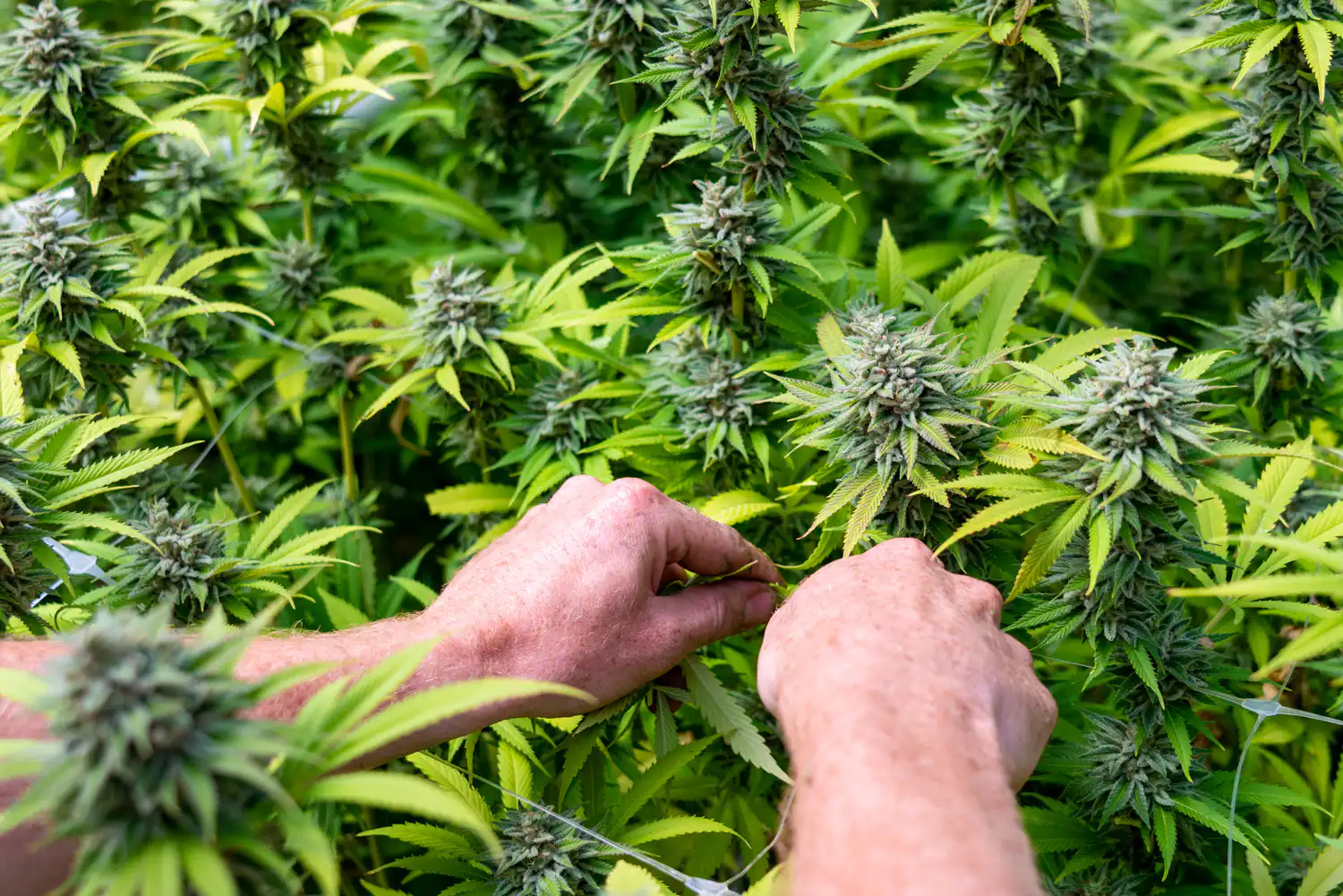
States that enact marijuana legalization see jobs in the agriculture sector increase more than they would have without the policy change, according to a new economic analysis from researchers at Texas Tech University.
The results, which were presented at the Agricultural & Applied Economics Association’s 2026 meeting last month, found a 9 percent uptick in agriculture sector employment in states that legalized cannabis—though wages did not increase proportionately due to factors that researchers determined are likely unrelated.
To investigate the relationship between marijuana legalization and industry-specific economic trends, analysts looked at state-level data from the U.S. Bureau of Labor Statistics’s (BLS) Quarterly Census of Employment and Wages from 1990 to 2024.
Applying a synthetic difference-in-difference (SDID) estimator, the researchers assessed “both aggregate and cohort-specific average treatment effects” on the target jurisdictions.
“The policy effectively increased agricultural employment.”
“Our baseline results indicate that legalization significantly increased agricultural employment by approximately 9 percent, while having no statistically significant effect on agricultural wages, all-industry employment, or economy-wide wages,” the study found.
“The baseline SDID estimates indicate that the policy achieved its primary objective of expanding agricultural employment, with treated counties experiencing an approximately 9 percent increase in agricultural employment relative to the synthetic counterfactual. However, this employment expansion did not translate into measurable changes in agricultural wages, all-industry employment, or economy-wide wages.”
Researchers said the “null wage response” to legalization, which seemed to be at odds with the “significant employment growth” they observed, likely isn’t related to the cannabis-specific policy factor. Rather, it’s “consistent with an elastic labor supply in the agricultural sector, where increased demand was absorbed through greater workforce participation rather than upward pressure on wages.”
“Policymakers should consider adoption timing and local labor market conditions when designing similar interventions, as the effectiveness of the policy varies considerably across cohorts,” the study authors said.
The cannabis sector is closely aligned with the agriculture industry, but legalization has had a wide range of economic impacts. For example, as of early 2026, direct jobs in the marijuana market reached about 412,500 U.S. workers, according to the U.S. Cannabis Jobs Report from Vangst and Whitney Economics
Meanwhile, legalizing medical marijuana appears to be associated with reduced rates of employees missing work—particularly in trades like manufacturing and agriculture where workers are more likely to experience symptoms such as pain that cannabis can help treat—according to a recent study.
Research published last year on marijuana legalization’s effect on workers’ compensation found that while the policy change was associated with a “gradual increase” in workers’ comp claims, the average cost per claim in fact fell after the policy change—as did patient use of prescription drugs, especially opioids and other painkillers.
In 2021, a separate study by the National Bureau of Economic Research found that adult-use cannabis legalization was associated with an increase in workforce productivity and decrease in workplace injuries.
Those researchers looked at the impact of recreational cannabis legalization on workers’ compensation claims among older adults, observing declines in such filings “both in terms of the propensity to receive benefits and benefit amount” in states that have enacted the policy change.
