

President Donald Trump signed an executive order Thursday to reclassify marijuana as a Schedule III drug, moving it out of the same category as heroin and LSD and placing it alongside drugs like Tylenol with codeine, which could have significant impacts in New Mexico.The order directs Attorney General Pam Bondi to expedite the federal process to reschedule marijuana. “This is the most significant policy change in 56 years in cannabis,” Matt Kennicott, Executive Director & Co-founder of the Cannabis Association of New Mexico told KOAT on Thursday. He expressed a desire for full de-scheduling and legalization but acknowledged this as “a step in the right direction.”Trump highlighted the accepted medical use of marijuana, “We have people begging for me to do this.” He noted that medical marijuana helps thousands of people with chronic pain or serious diseases, adding, “I can’t tell you. I think I probably have received more phone calls on this,” and, “I don’t think I received any calls on the other side of it.”The Cannabis Association of New Mexico also emphasized the potential research benefits, stating, “hopefully, this will loosen up grants on the medical side of things and allow deeper and better research to take place.” Kennicott mentioned the financial relief this could bring to local businesses in the form of tax relief, “right now, as cannabis businesses, we can’t really operate as normal businesses because of a provision in the IRS Code 280E.” He added, “We do know from the details that we have that tax provisions will be loosened up.It could help in terms of tax deductions for everyday expenses like gloves and scissors used in handling marijuana plants. “Those types of things will be able to be deducted,” Kennicott said.The order instructs the U.S. Attorney General to move quickly to loosen federal restrictions, as medical marijuana is now legal in 40 states and Washington, D.C., with many states, including New Mexico, also allowing recreational use. No official timeline has been announced for when the federal change would take effect, and making marijuana legal to possess in the U.S. would still require congressional approval.
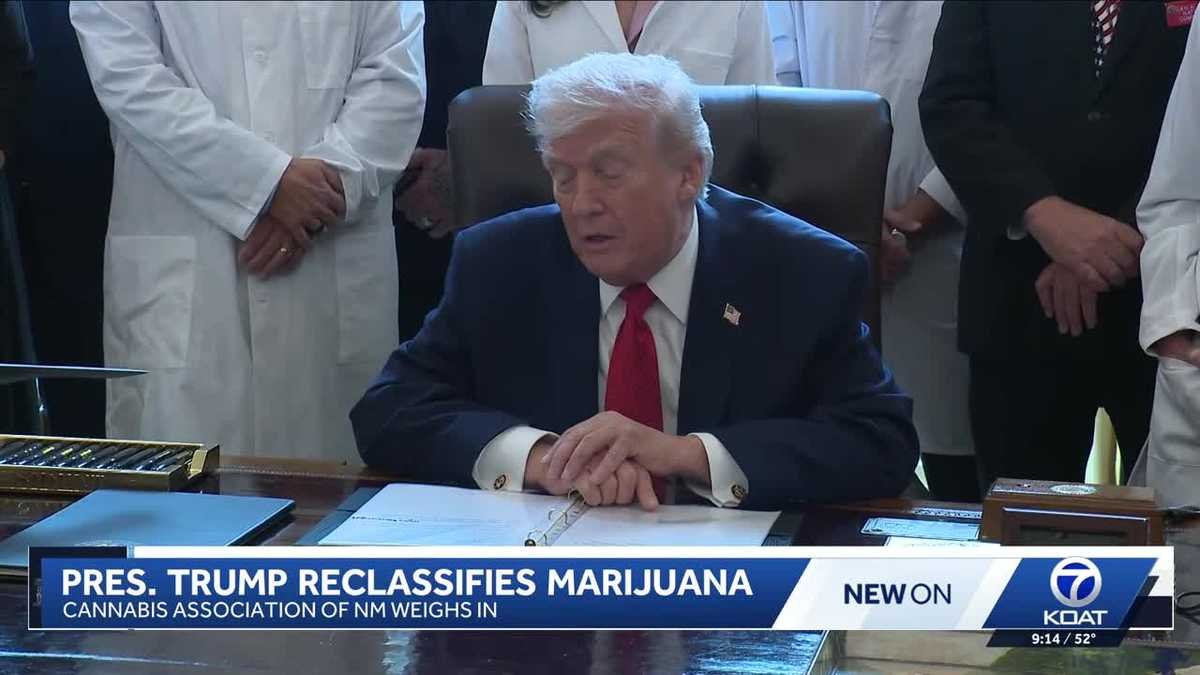
President Donald Trump signed an executive order Thursday to reclassify marijuana as a Schedule III drug, moving it out of the same category as heroin and LSD and placing it alongside drugs like Tylenol with codeine, which could have significant impacts in New Mexico.
The order directs Attorney General Pam Bondi to expedite the federal process to reschedule marijuana.
“This is the most significant policy change in 56 years in cannabis,” Matt Kennicott, Executive Director & Co-founder of the Cannabis Association of New Mexico told KOAT on Thursday. He expressed a desire for full de-scheduling and legalization but acknowledged this as “a step in the right direction.”
Trump highlighted the accepted medical use of marijuana, “We have people begging for me to do this.” He noted that medical marijuana helps thousands of people with chronic pain or serious diseases, adding, “I can’t tell you. I think I probably have received more phone calls on this,” and, “I don’t think I received any calls on the other side of it.”
The Cannabis Association of New Mexico also emphasized the potential research benefits, stating, “hopefully, this will loosen up grants on the medical side of things and allow deeper and better research to take place.”
Kennicott mentioned the financial relief this could bring to local businesses in the form of tax relief, “right now, as cannabis businesses, we can’t really operate as normal businesses because of a provision in the IRS Code 280E.” He added, “We do know from the details that we have that tax provisions will be loosened up.
It could help in terms of tax deductions for everyday expenses like gloves and scissors used in handling marijuana plants. “Those types of things will be able to be deducted,” Kennicott said.
The order instructs the U.S. Attorney General to move quickly to loosen federal restrictions, as medical marijuana is now legal in 40 states and Washington, D.C., with many states, including New Mexico, also allowing recreational use.
No official timeline has been announced for when the federal change would take effect, and making marijuana legal to possess in the U.S. would still require congressional approval.
